Aden — the Aeronaut Hunter
A gaunt young man seeking belonging, survives the great storm, drawn into the island's secret law and a perilous love.

Characters of Airovale
Character Video: MAHALA · 20 Seconds
© 2026 Aurous Publishing. All rights reserved. Privacy policy
Mahala is the guardian of the temple gold on the Crescent Islands, and the reason aeronauts lower their voices when they talk about the islands at all. She is ageless and flawless, her skin unmarked, her hair worn loose in the salt wind, hung with gold and belted in red, a figure who would pass unremarked in any harbor tavern until she looked at you. Sailors call her a witch, a legend, a warning.
Her beauty was never a gift. It was a payment, and she knows to the coin what it cost. Mahala is proud, bitter and patient, and she has had centuries to practise all three. She guards what was left in her care with a devotion that looks like cruelty from the outside and feels, from the inside, like the only purpose she has left. Whether she is a monster or a prisoner is the argument her chapters invite you to have.
The crew of the Gilded Star has come for copper and a legend, and they find the temple. Its gold is not hidden. It lies in rings around a pool of black water and molten rock, as if it had been set out and left for them. The crew takes what it can carry, one of them laughs at the word curse, and from a dark niche beyond the torchlight a pair of patient eyes watches them go.
Mahala steps into the emptied chamber when the echoes fade. She sees the wreckage of the theft, and among it she finds something that tells her exactly whom to blame. Then she walks to the black sand at the water’s edge, and the sky begins to answer.
Read it in The Crescent Islands, watch it as Episode 2, or hear the chapter’s score in Mahala’s Curse.
No one in Airovale pays more visibly for a bargain than Mahala. She asked the darkness to give back what the fire had taken, and it did, with interest: beauty without end, and an island she can never leave. The Law of Exchange does not forgive a debt because it was made in pain, and it does not read the small print aloud. The gold that fills her temple is not a hoard. It is her end of the arrangement, and she guards it the way a debtor guards the last coin.
That is why the storm follows the theft. Her bargain says what happens when the gold leaves, and she has every reason to answer quickly. See the saga’s clearest examples of the Law at work in The Law in Action.
Mahala and Malina were twin sisters before they were anything else. When the volcano woke, Malina carried Mahala out of the fire and nursed her through the long recovery, and Mahala never forgave her for it. Gratitude curdled into envy: the sister who was whole, watching over the sister who was not. The wish that followed rewrote both of their lives.
Centuries later, one is a healer in Airovale and one is a guardian on a beach, and each is still answering what the other did. Meet Malina, or read the author’s essay Sympathy for the Villain?, which tells Mahala’s story from the beginning.
Mahala’s weapon is Aelmir, the storm giant of the Southern Sea. Aeronauts across that water tell of a bearded figure who walks the clouds and tears ships apart with thunder, lightning and fierce wind. Aelmir answers to no mortal, but he answers to Mahala. She calls him from the water’s edge, in a language older than the stone beneath her feet.
The ships carrying the gold are the ones he comes for. What the storm does to the fleet is told across Episode 2 and Episode 3; it is enough here to know that the sea always returns what was taken, and that this is the point.
Watch Mahala’s story: Sympathy for the Villain?
Before the curse and before the storms, Mahala was a vineyard worker whose beauty was part of who she was. This one-minute video follows her from the eruption on the Crescent Islands toward the bargain that changed her, and asks the question in its title: “Did I ask too much from this life? Or not enough to live it right?”
Read the full essay, Sympathy for the Villain?, for the story behind the video.
Mahala is the guardian of the temple gold on the Crescent Islands, an ageless sorceress who calls the storm giant Aelmir against anyone who takes it. She is the twin sister of Malina, the healer and seer of Airovale.
She is one of the saga’s antagonists and also one of its most sympathetic. Her cruelty has a cause, and the story shows both sides: a woman wronged by fire and fate who has had centuries to turn that into wrath. The author’s essay Sympathy for the Villain? explores the question.
Yes. She and her twin Malina both gained a lasting youth through a bargain Mahala made after a volcanic eruption. Hers came with a condition: she is bound to the Crescent Islands as guardian of the temple gold.
Aelmir is the storm giant of the Southern Sea, a force of nature who appears in the clouds with thunder, lightning and fierce winds. Mahala calls him against the airships that carry off the temple gold. He has his own entry among the characters of Airovale.
Mahala appears in person in Chapter 2, The Crescent Islands, and her storm drives Chapter 3, Curse of the Temple Gold. The film episodes share those titles.
The Airovale novel is the fullest telling of Mahala’s story. It comes as a paperback or ebook and as an audiobook, and the story is the same in each. The film episodes are free to watch, and her song Mahala’s Curse is on the soundtrack.
Meet the rest of the characters & fae, including Malina and Aden, visit the Crescent Islands, or learn the Law of Exchange that binds them.

Video episodes of each chapter
This carousel auto-advances. Use the pause button to stop autoplay. Navigate through 10 episodes of the Airovale steampunk fantasy series.





Time is the only treasure

Flip through all 29 pages inside our brass-fitted steampunk reader — then take it with you.
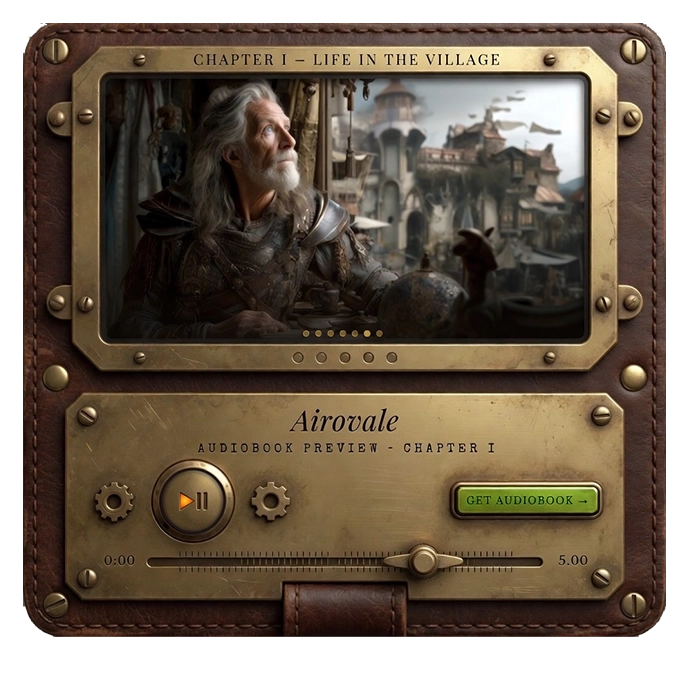
Stream a full chapter preview right here — then unlock all ten chapters for less than a cup of coffee.
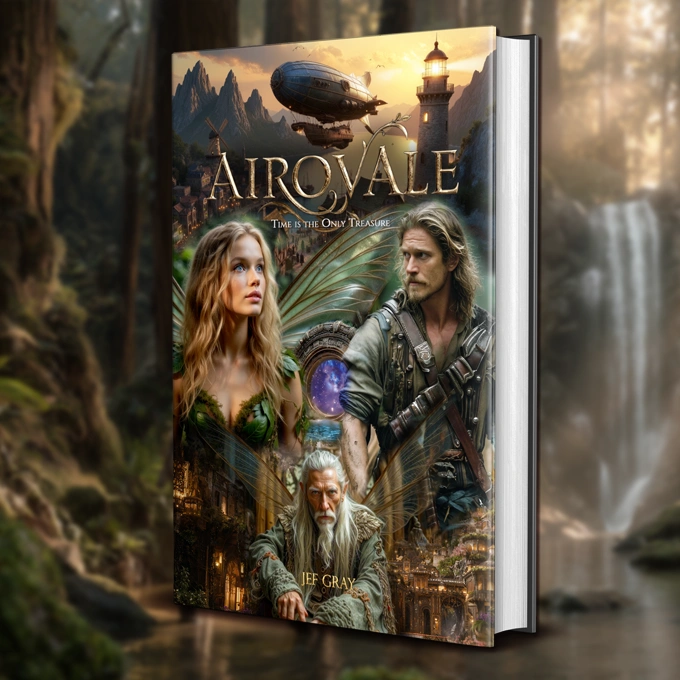
169 pages of steampunk fantasy — a signed-quality paperback to keep on the shelf or gift to a reader.
Yes — the story content is identical across all three formats. The only difference is the chapter illustrations, which appear in the ebook and paperback but not the audiobook.
Absolutely. The video episodes present a glimpse of the scenery set to the soundtrack's emotional journey, while the book is where the characters' thoughts and dialogue come through — the full interior experience of the story.
Airovale is appropriate for teens ages 16+. The content touches on mature themes including dueling, the penalty of death, greed, immortality, and coming-of-age young adult romance.
The romance in Airovale is written at a young adult level, with no graphic content beyond a few kisses. It centers on the two main characters as their journey to a forbidden ruin reveals ancient secrets about the island they inhabit, and their relationship grows into love and a decision to be together.
No warning needed. Airovale is a romantic adventure story, safe for readers ages 16 and up, with no graphic moments beyond a kiss.
Airovale is a series. The first book introduces the story, and additional books — two or more to complete the arc — are currently in development.
Not exactly. Steampunk fantasy with time travel exists, and fantasy with fae exists, but few stories combine both. The closest comparisons are Carnival Row (Amazon Prime Video) or The Anubis Gates (Tim Powers) — though Airovale is a wholly original fantasy world with no historical setting.
Primarily, Airovale is a story told through three lenses: book, video, and music. The website and companion channel (Roku TV) present short cinematic episodes alongside a complete original soundtrack, while the book is the deepest way to experience the full story — the center of the Airovale experience.
Desktop · Mobile · Video Calls
Every scene in Airovale was rendered as a world worth living in. Now those worlds are yours to keep — on your screen, your phone, and your next video call.
Free for desktop & mobile · 1080p & 4K for Zoom, Teams, Webex & Google Meet · Terms of use